
Webuild and Odebrecht Selected as Preferred Bidders for Lobito Copper Railway
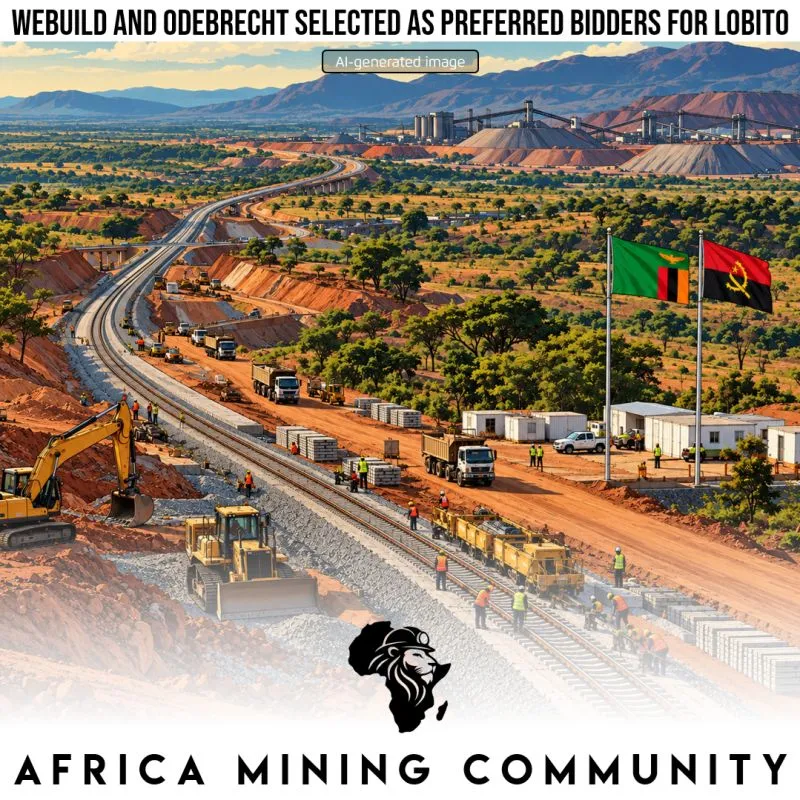
Webuild and Odebrecht advance the Lobito Corridor railway, strengthening copper and cobalt export routes from Zambia and DRC to Angola.
Italian construction giant Webuild and Brazilian engineering company Odebrecht Engenharia & Construção have emerged among the preferred bidders for the construction of an 830-kilometer railway section of the strategically important Lobito Corridor, a major cross-border infrastructure initiative designed to improve mineral transportation between Zambia, the Democratic Republic of Congo (DRC), and Angola. The project represents a significant advancement in efforts to establish a more efficient export route for copper, cobalt, and other critical minerals from Central Africa's mineral-rich regions to international markets through Angola's Atlantic coastline.
The Africa Finance Corporation (AFC), which serves as the lead developer for the Zambian section of the railway, has selected construction consortiums involving Webuild, Odebrecht, Portuguese infrastructure group Mota-Engil, and Turkish construction company IC İÇTAŞ İnşaat to advance negotiations for major construction contracts. Under the proposed arrangements, Webuild, Mota-Engil, and IC İÇTAŞ are negotiating the development of the railway section connecting Chingola, a major copper-mining center in Zambia, to the Angolan border. Meanwhile, Mota-Engil and Odebrecht are negotiating construction responsibilities for the section extending from the border to Luacano in Angola. These negotiations represent an important step toward securing the engineering expertise, construction capacity, and technical resources required to deliver the large-scale railway development.
The broader Lobito Corridor railway network, spanning approximately 1,739 kilometers, is intended to connect Kolwezi, one of the Democratic Republic of Congo's most important copper and cobalt mining centers, with the Atlantic port of Lobito in Angola. By strengthening rail connectivity across the three countries, the corridor is expected to provide mining companies with an alternative transportation route to global markets. Improved railway infrastructure could reduce dependence on lengthy road transport operations, ease logistical bottlenecks, lower freight costs, and improve the reliability of mineral exports. These improvements are particularly important for Zambia and the DRC, two of Africa's leading copper-producing countries, with the DRC also maintaining its position as the world's largest producer of cobalt.
The project has attracted considerable international attention, particularly from the United States, which has provided financial backing as part of its broader strategy to strengthen access to critical minerals and diversify global mineral supply chains. Copper is increasingly important for electricity transmission, renewable energy infrastructure, and industrial electrification, while cobalt remains a significant material in several rechargeable battery technologies. By supporting the Lobito Corridor, Washington aims to establish more diversified and resilient supply routes for minerals essential to advanced manufacturing and the global energy transition. The railway also forms part of wider geopolitical efforts to reduce the concentration of critical mineral supply chains around China, which holds a dominant position in several mineral processing and refining industries.
According to Samaila Zubairu, President and Chief Executive Officer of AFC, the selection of preferred construction bidders marks a significant milestone in advancing the project toward implementation. Negotiations are expected to begin in the following month, with construction agreements anticipated to be finalized within eight to twelve weeks after discussions commence. AFC has also indicated that physical construction activities could begin within six to eight months, subject to the successful completion of contractual negotiations and other project requirements. These anticipated milestones demonstrate the developers' intention to accelerate implementation of an infrastructure project regarded as central to regional trade connectivity and mineral export competitiveness.
Beyond facilitating the international shipment of raw materials, AFC expects the Lobito Corridor to become an important catalyst for broader economic development across Southern and Central Africa. Improved transport infrastructure could encourage investment in mineral processing facilities, manufacturing operations, agricultural production, and logistics services along the railway route. Enhanced connectivity may also help regional producers access new consumer markets, improve the movement of agricultural commodities, and support the development of industrial and commercial activity in communities located along the corridor. By connecting mining districts with ports, production centers, and regional trading networks, the railway could contribute to greater economic integration among Zambia, Angola, and the Democratic Republic of Congo.
From a broader economic perspective, the successful development of the Lobito Corridor could strengthen Africa's position within international critical mineral supply chains while improving the competitiveness of its mining sector. More efficient transportation infrastructure may attract additional exploration and mining investment, reduce operational costs for existing producers, and create opportunities for local mineral beneficiation and industrial diversification. However, the scale of these benefits will depend on timely project delivery, sustainable financing arrangements, effective cross-border coordination, and policies that encourage domestic value addition rather than an exclusive focus on raw mineral exports. If these conditions are achieved, the corridor could become an important driver of regional economic growth, employment creation, and long-term industrial development, while providing African mineral-producing countries with greater access to diversified international markets.
Mini-Glossary
- Preferred Bidder: A company or consortium selected to enter advanced contract negotiations before a final construction agreement is awarded.
- Critical Minerals: Mineral resources considered essential for strategic industries, advanced technologies, and energy infrastructure.
- Mineral Beneficiation: Processing raw mineral resources to improve their commercial value before sale or export.
- Supply Chain Diversification: Reducing reliance on a limited number of suppliers, countries, or transportation routes.
- Logistical Bottlenecks: Transportation or infrastructure limitations that delay the movement of goods and increase operational costs.
- Value Addition: Increasing the economic value of raw materials through processing, refining, or manufacturing.
- Industrial Diversification: Expanding an economy into additional industries to reduce dependence on a narrow range of economic activities.