
Tanzania Extends Barrick's North Mara Gold Mine Licences for 15 Years
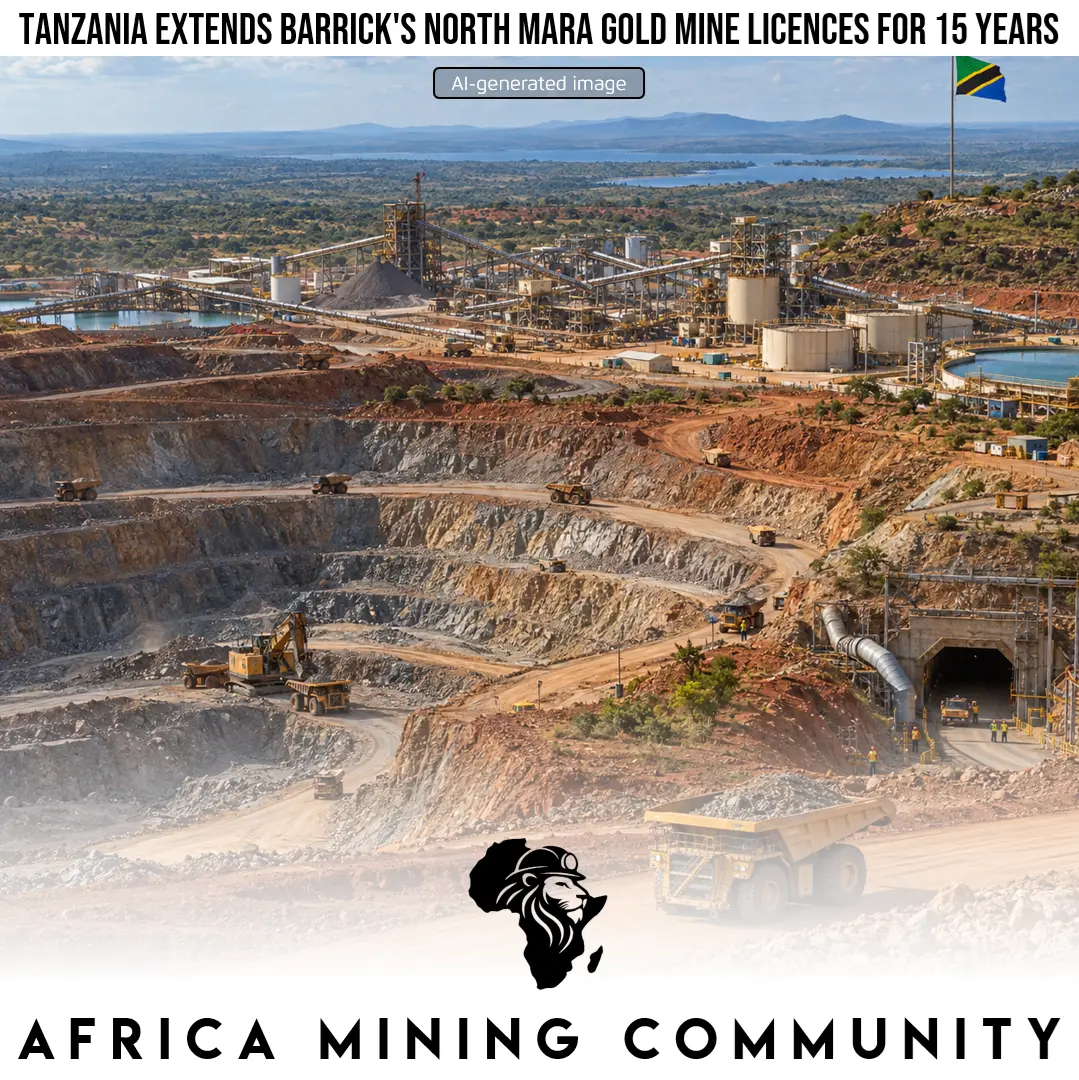
Tanzania renews Barrick’s North Mara gold mine licences for 15 years as the miner targets a production recovery and evaluates expansion.
Tanzania has renewed the two Special Mining Licences covering Barrick Mining Corporation’s North Mara gold mine for a further 15 years, providing long-term operating certainty for one of the country’s most significant gold assets. The extension removes a major tenure risk at a time when Barrick is evaluating potential expansion of its broader North Mara-Bulyanhulu gold complex, although the company still faces a significant operational challenge as it works to recover production following a sharp decline during the first half of 2026. Barrick confirmed the licence renewal on October 6, saying the decision would allow continued investment in the mine, its workforce and surrounding communities.
North Mara is located in Tanzania’s north-western Mara Region, approximately 20 kilometres south of the Kenyan border. The operation combines open-pit and underground mining, with ore sourced principally from the Nyabirama open pit and the Gokona underground deposit. Its processing plant is capable of treating an average of around 8,000 tonnes of ore per day. Commercial production began in 2002, establishing North Mara as a long-life contributor to Tanzania’s gold mining industry.
The mine is operated through Tanzania’s partnership framework with Barrick. The Tanzanian government holds a 16% interest, while Barrick holds the remaining 84%. North Mara and the nearby Bulyanhulu mine are managed through Twiga Minerals Corporation, the joint venture structure established between Barrick and the government following the restructuring of their relationship in 2019. Under the arrangement, the partners share the economic benefits generated by the operations equally, while the government also retains its direct ownership stake.
North Mara produced approximately 249,000 attributable ounces of gold in 2025, making it an important contributor to Barrick’s African portfolio. The mine also retains a substantial reserve base that supports its longer-term development potential. At the end of 2025, North Mara contained attributable proven and probable gold reserves of about 3.2 million ounces, comprising roughly 43 million tonnes of ore grading an average 2.32 grams of gold per tonne. Of this total, about 2.2 million ounces were associated with surface reserves and approximately 1.1 million ounces with underground reserves.
Despite the strength of its reserve base, North Mara experienced a difficult start to 2026. Attributable gold production during the first half of the year fell by 47% year-on-year to approximately 68,000 ounces, compared with 129,000 ounces during the corresponding period of 2025. The weaker production performance was accompanied by a substantial increase in operating costs. All-in sustaining costs rose 79% to US$2,283 per ounce, compared with US$1,272 per ounce a year earlier, with lower ore grades among the factors contributing to the deterioration in cost performance.
Barrick has nevertheless maintained North Mara’s 2026 attributable production guidance at between 200,000 and 230,000 ounces. Reaching that target will require a significant improvement during the second half of the year. Following production of only 68,000 ounces in the first six months, the mine needs to deliver between approximately 132,000 and 162,000 ounces during the second half to achieve the full-year guidance range. Barrick has also retained its 2026 all-in sustaining cost guidance for the operation at between US$1,520 and US$1,680 per ounce.
The company expects production to strengthen in 2027 and is studying technical improvements intended to address processing constraints and improve the efficiency of the operation. Potential plant upgrades and debottlenecking initiatives could increase throughput and improve the mine’s ability to convert its substantial mineral inventory into sustainable production. Barrick is also assessing broader expansion opportunities across the combined North Mara-Bulyanhulu complex, which could support a larger and more integrated Tanzanian gold business over the longer term.
The renewed licences also reinforce the importance of Barrick’s operations to Tanzania’s wider economy. According to the company, its Tanzanian businesses have contributed approximately US$5.3 billion to the national economy since 2019 through taxes, royalties, wages, dividends and local procurement. Around US$1.2 billion of that contribution was generated in 2025 alone. Barrick says Tanzanian nationals account for 96% of its approximately 3,000 employees in the country, while more than 90% of procurement is sourced from Tanzanian-registered companies.
The licence renewal comes immediately ahead of a separate legal proceeding in London involving allegations connected with North Mara. A High Court trial involving the London Bullion Market Association, or LBMA, is scheduled to begin on October 7, 2026. The case was brought on behalf of relatives of two Tanzanian artisanal miners who allegedly died in incidents at North Mara in 2019. The claimants allege that the LBMA was negligent in continuing to accredit a refinery that sourced gold from the mine. The LBMA denies legal responsibility and maintains that its role concerns the accreditation of refiners rather than mines. Barrick is not a defendant in the case.
For Tanzania’s mining industry, the 15-year licence extension provides an important signal of regulatory continuity for a major foreign investor and could support further capital expenditure, mine-life extensions and employment around North Mara and Bulyanhulu. Greater tenure certainty may also make it easier for Barrick to justify processing upgrades and larger expansion projects, potentially strengthening Tanzania’s position as one of Africa’s established gold-producing jurisdictions. However, the economic benefits will depend heavily on operational execution. North Mara must restore grades and production, lower its elevated cost base and demonstrate that its reserve inventory can be converted efficiently into profitable ounces. At the same time, continued scrutiny of environmental, social and human-rights practices across international gold supply chains means that operational performance, community relations and responsible sourcing standards are likely to remain closely connected to the long-term investment outlook for Tanzania’s gold sector.
Mini-Glossary
- Special Mining Licence: A government-issued permit allowing a company to develop and operate a large-scale mining project for a specified period.
- Attributable production: The portion of a mine’s total production allocated to a company according to its ownership or economic interest.
- All-in sustaining costs, AISC: An industry measure of the overall cost of maintaining existing gold production, including operating expenses, sustaining capital and certain administrative costs.
- Ore grade: The concentration of a valuable mineral or metal contained in mined material, commonly expressed as grams per tonne for gold.
- Proven and probable reserves: Mineral deposits demonstrated through technical and economic studies to be commercially mineable under specified conditions.
- Debottlenecking: Technical or operational improvements designed to remove constraints that limit the capacity or efficiency of a mine or processing plant.
- Throughput: The quantity of ore or material that a processing facility can treat over a given period.
- Tenure risk: The risk that a mining company could lose, fail to renew, or face restrictions on the legal rights required to operate a mineral property.
- Local procurement: The purchase of goods and services from suppliers based or registered within the host country.
- Artisanal miner: A person involved in small-scale mining, usually using relatively basic equipment and methods.
Editor: Vural Burç ÇAKIR