
Prospect Confirms New High Grade Copper Zone at Mumbezhi Project
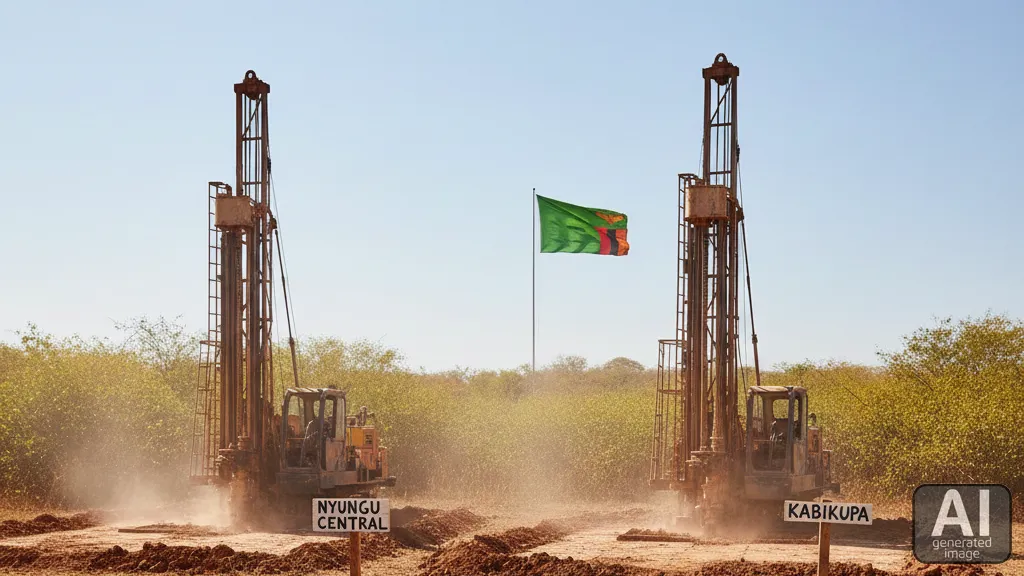
Prospect confirms new high grade copper zones at Mumbezhi as Phase 2 drilling and geophysics strengthen resource growth heading into 2026.
Prospect Resources has entered an important phase of advancement at the Mumbezhi Copper Project in Zambia, with new Phase 2 drilling results confirming the presence of high grade copper zones at both the Nyungu Central and Kabikupa deposits. These latest assays not only demonstrate the continuity of mineralisation but also highlight the potential for expanding near surface resources, a factor that could significantly enhance the project’s development outlook heading into 2026. The combination of drilling, ongoing geophysical work and forthcoming Mineral Resource updates signals a period of strong momentum for the broader Mumbezhi district.
At Nyungu Central, recent results have reinforced confidence in the deposit’s shallow high grade potential. The standout intercept of 34 metres at 0.88 percent copper from 128 metres depth, complemented by 2.7 metres at 0.52 percent copper from 114.3 metres, underscores the robustness of the mineralised system. Additional intervals, including 8.46 metres at 0.34 percent copper and 6.0 metres at 0.42 percent copper from hole NCMT001, as well as 2.06 metres at 0.33 percent copper from hole NCDD017, further support the prospect of building new near surface tonnage. These results suggest strong continuity within the mineralised horizons and position Nyungu Central as a key driver of future resource growth.
Kabikupa has delivered similarly compelling outcomes, marking the completion of its Phase 2 drill program. Final assay intervals reached up to 18.6 metres at 0.48 percent copper and 13.6 metres at 0.56 percent copper from hole KKMT001, demonstrating that the deposit hosts consistent, broad zones of copper mineralisation. In total, the combined Phase 2 program encompassed 14,770 metres of diamond drilling and 3,500 metres of shallow aircore drilling across 165 holes. While four Nyungu Central assays remain pending, expected by mid January 2026, the completed datasets already provide a solid foundation for the updated Mineral Resource Estimates scheduled for release in Q1 2026.
Beyond drilling, a comprehensive suite of geophysical and geochemical activities is helping Prospect refine and expand its exploration model across the Mumbezhi Project area. Airborne electromagnetic and induced polarisation surveys have identified several new regional targets, offering potential for further discoveries beyond the currently drilled zones. Metallurgical composite samples from Kabikupa are now undergoing analysis, with results anticipated in February 2026, while licence wide soil geochemical survey findings are due by late December. These datasets will collectively inform future drill planning and support more accurate resource modelling.
Taken together, the continuing flow of high grade intercepts, the strength of geophysical anomalies and the imminent MRE updates underscore the growing scale and quality of the Mumbezhi Copper Project. For Zambia and the wider African mining sector, advances at Mumbezhi highlight the region’s deep prospectivity for copper and the strategic importance of sustained exploration investment. Successful resource expansions could attract additional capital, stimulate local development and reinforce Zambia’s position as a key supplier of copper, a critical metal for global electrification and industrial growth.
Mini Glossary
- Aircore drilling: A drilling method using compressed air to recover loose chips, typically for shallow geochemical sampling.
- AEM (Airborne Electromagnetics): A geophysical survey technique that maps subsurface conductivity to help identify mineralisation.
- Induced Polarisation (IP): A method that measures the chargeability of rocks to detect sulphide rich mineralised zones.
- Tonnage growth: An increase in the total amount of mineralised material defined by drilling and resource modelling.
- Metallurgical composites: Samples combined from multiple drill intervals to test how minerals respond to processing.
Editor: Vural Burç ÇAKIR