
Perseus Mining Achieves First Ore Crushing Milestone at Nyanzaga Gold Project
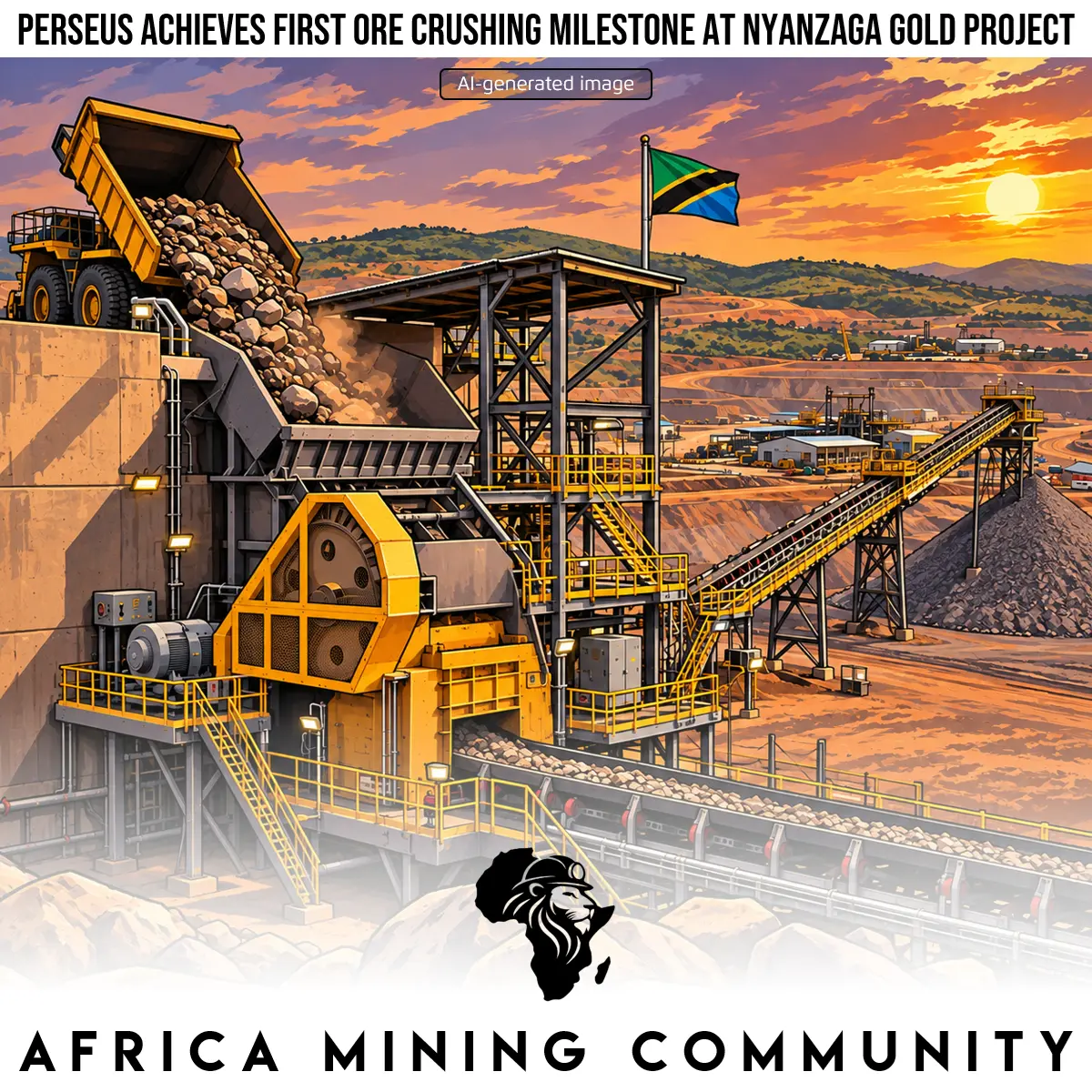
Perseus Mining advances Tanzania's Nyanzaga Gold Project with first ore crushing, major construction milestones and first gold targeted for early 2027.
Perseus Mining has achieved a significant operational milestone at its Nyanzaga Gold Project in Tanzania, successfully introducing the first ore into the primary crushing system as the development advances towards commercial production. The achievement marks a critical transition from construction to commissioning, bringing the project closer to its planned first gold pour in early 2027. With major processing infrastructure nearing operational readiness and mining activities progressing ahead of schedule, Nyanzaga is steadily positioning itself as an important addition to Perseus Mining’s African gold production portfolio.
The latest development involved the successful transfer of ore from the Run-of-Mine (ROM) pad through the primary crushing system to the Coarse Ore Stockpile (COS). This represents an essential step in validating the initial stages of the mineral processing circuit, which will ultimately prepare mined material for grinding, gold recovery and subsequent production. The introduction of first ore also provides an opportunity for the commissioning team to assess equipment performance, verify material-handling systems and identify potential operational adjustments before full-scale processing begins. As commissioning activities intensify, the project is moving progressively towards integrated plant testing and eventual production readiness.
One of the most notable achievements at Nyanzaga has been its exceptional occupational health and safety performance throughout the construction phase. The project has recorded more than 12 million working hours without a lost-time injury, reflecting a strong emphasis on workforce protection, operational discipline and systematic risk management. Additionally, Nyanzaga has maintained a Total Recordable Injury Frequency Rate (TRIFR) of just 0.41, demonstrating a low incidence of recordable workplace injuries relative to total hours worked. These results are particularly significant given the operational complexity, heavy equipment requirements and large workforce typically associated with developing a major gold mining operation.
Progress across the project's processing infrastructure has also been substantial. Lining activities for both the Semi-Autogenous Grinding (SAG) mill and ball mill have been completed, representing an important advancement in preparing the comminution circuit for commissioning. These mills will play a central role in reducing crushed ore into finer particles, allowing gold-bearing minerals to become accessible for downstream extraction and recovery. With the mill lining work finalised, the commissioning team can advance preparations for mechanical testing, equipment integration and the gradual introduction of material through subsequent processing stages.
Another major construction achievement is the completion of the Tailings Storage Facility (TSF), an essential component of the project's environmental management and operational infrastructure. The facility is designed to accommodate the residual materials generated during mineral processing, supporting the controlled management of mining waste. Its construction completion represents an important step towards operational readiness, although ongoing monitoring, appropriate operating procedures and regulatory compliance will remain necessary throughout the mine's operating life. Effective tailings management will be particularly important in maintaining environmental performance and supporting the long-term sustainability of the operation.
Mining activities are also progressing positively, with material movement currently ahead of the project's planned schedule. This progress indicates that mine development and associated earthmoving operations are advancing efficiently, potentially strengthening the availability of ore for processing during the initial production ramp-up. Maintaining adequate ore inventories is important during commissioning because it allows processing facilities to be tested under increasingly representative operating conditions while reducing the risk of interruptions caused by insufficient feed material. The strong performance of mining operations could therefore support a more coordinated transition between the mine and processing plant as Nyanzaga approaches its first production milestones.
Beyond the processing plant and mining areas, supporting infrastructure has continued to advance. Construction of the project's camp facilities has been completed, providing accommodation and essential services for personnel involved in commissioning and future operations. Meanwhile, development of the 220-kilovolt (kV) grid connection has entered its final construction stages, with commissioning scheduled to begin in late November 2026. The grid connection is a particularly important infrastructure component because large-scale gold processing operations require substantial and reliable electricity supplies to power crushing equipment, grinding mills, pumping systems and other critical facilities. Successful commissioning of the electrical infrastructure will therefore be essential to achieving stable processing operations and supporting the project's longer-term production objectives.
With the commissioning team mobilised and activities increasing across key operational areas, Perseus Mining is now concentrating on integrating the project's major systems and preparing the processing plant for its initial gold production. The successful introduction of first ore, completion of major construction components and continued advancement of supporting infrastructure collectively indicate that Nyanzaga is progressing towards its targeted first gold pour in early 2027. However, achieving this objective will depend on the successful commissioning of the remaining systems, reliable equipment performance and the effective integration of mining, processing and power infrastructure.
The Nyanzaga Gold Project's progress could have meaningful implications for Tanzania's mining industry and the broader East African gold sector. As the project moves towards production, it has the potential to contribute to Tanzania's gold output, strengthen mineral export revenues and generate economic activity through employment, procurement and demand for mining-related services. Its development may also reinforce investor confidence in Tanzania's capacity to accommodate large-scale international mining investments, particularly where infrastructure development, operational safety and project execution demonstrate positive results. For Perseus Mining, Nyanzaga represents an opportunity to expand its production base and strengthen its geographic presence within Africa. Nevertheless, the extent of these benefits will depend on the project's successful transition into sustained commercial operations, prevailing gold market conditions, production costs and the effectiveness of local economic participation.
Mini-Glossary
- Commissioning: The process of testing and preparing newly constructed equipment and facilities to ensure they operate safely and efficiently before regular production begins.
- Run-of-Mine (ROM) Pad: A designated area where mined ore is temporarily stored before entering the processing plant.
- Coarse Ore Stockpile (COS): A storage area for crushed ore before it moves into the grinding and further processing stages.
- Primary Crusher: Heavy-duty equipment that breaks large pieces of mined rock into smaller, more manageable fragments.
- Lost-Time Injury (LTI): A work-related injury that prevents an employee from returning to their normal duties for at least one subsequent scheduled work shift.
- Total Recordable Injury Frequency Rate (TRIFR): A safety performance indicator measuring recordable workplace injuries relative to hours worked, commonly expressed per one million working hours.
- Semi-Autogenous Grinding (SAG) Mill: A large grinding machine that uses the ore itself, together with steel grinding balls, to reduce rock particle size.
- Ball Mill: A rotating cylindrical machine containing steel balls that grind crushed material into finer particles for mineral recovery.
- Comminution Circuit: The combined crushing and grinding processes used to reduce ore into particles suitable for mineral extraction.
- Tailings Storage Facility (TSF): An engineered facility designed to store and manage residual materials remaining after valuable minerals have been extracted.
- Production Ramp-Up: The gradual increase in mining or processing activity until an operation reaches its intended production capacity.
- First Gold Pour: The initial production of gold, typically in the form of doré bars, marking an important milestone in a mine's development.
- Kilovolt (kV): A unit of electrical potential equal to 1,000 volts, commonly used to describe high-voltage electricity transmission infrastructure.