
Guinea’s Simandou Ships Its First Iron Ore Cargo to Europe
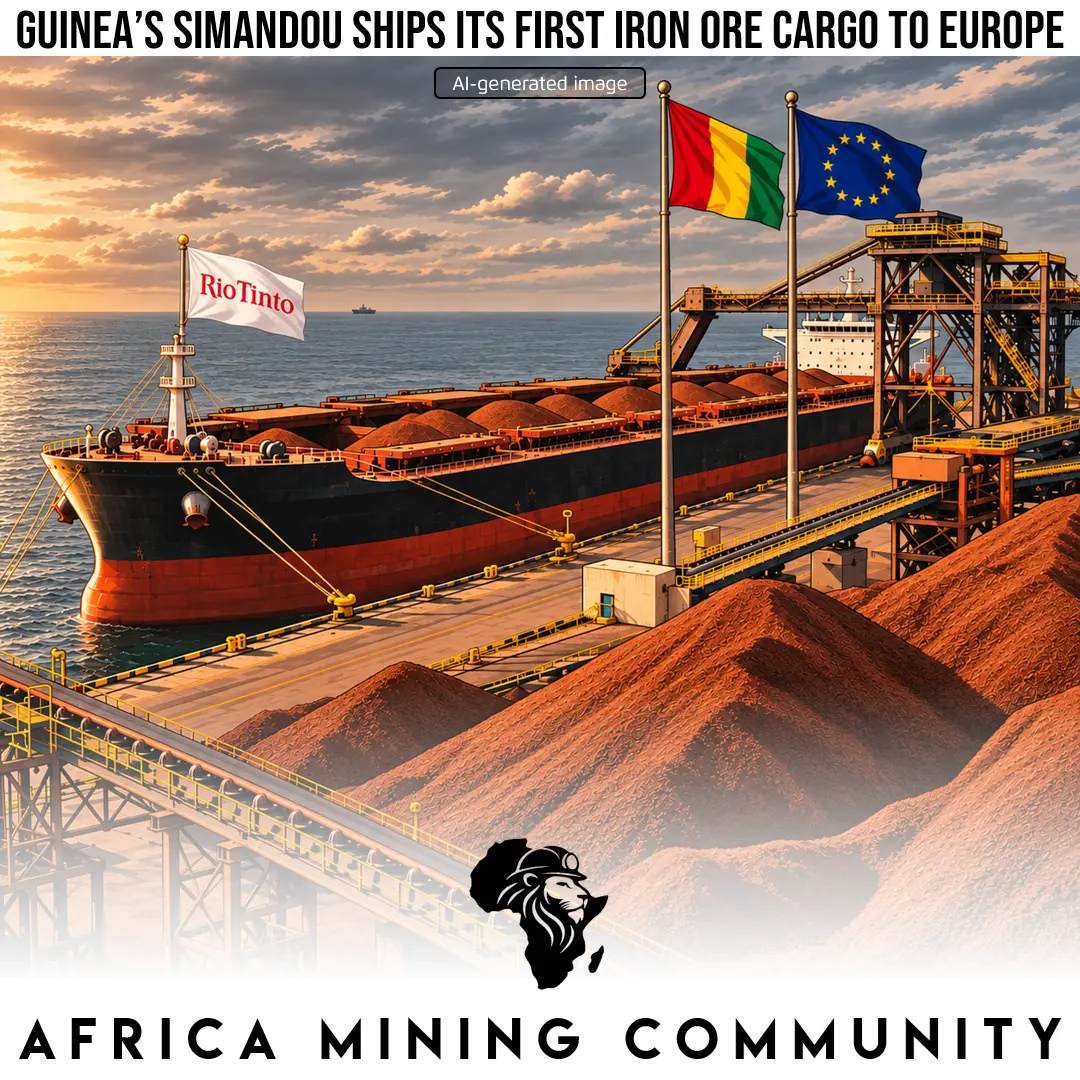
Guinea’s Simandou ships its first iron ore cargo to Europe, expanding global market access and strengthening its role in the steel supply chain.
Rio Tinto has shipped the first Europe-bound iron ore cargo from Guinea’s giant Simandou mining project, marking a significant milestone in the project's commercial expansion and the diversification of Guinea’s international export markets beyond China. The development reflects Simandou’s growing integration into the global iron ore supply chain and its emerging role as a strategic supplier of high-grade raw materials to the European steel industry.
A vessel carrying 79,081 tonnes of iron ore fines departed Guinea’s Morebaya port on November 23, 2026, and is expected to arrive in Dunkirk, France, in early December. The shipment was organized by Simfer, the Rio Tinto-led joint venture responsible for developing and operating Simandou’s two southern mining blocks. Meanwhile, a second Europe-bound cargo is being loaded for delivery to Gijón, Spain. Both Dunkirk and Gijón host steelmaking facilities operated by ArcelorMittal, highlighting the potential for stronger commercial relationships between Guinea’s emerging iron ore industry and European steel producers.
The shipments come as Simandou continues to ramp up production towards its targeted annual capacity of 120 million tonnes across its four mining blocks. Guinea’s monthly iron ore exports surpassed 5 million tonnes for the first time in October 2026, demonstrating the country's rapidly expanding production and export capabilities. According to the Baltic and International Maritime Council (BIMCO), Guinea’s cumulative iron ore shipments reached 22 million tonnes during the first ten months of 2026.
The Simandou project is being jointly developed by Rio Tinto, Chinalco, Baowu and their respective consortium partners through two separate mining ventures. The Guinean government holds a 15% stake in each venture, ensuring direct state participation in the development and commercial exploitation of the country's iron ore resources. The project's extensive railway and port infrastructure is also expected to strengthen Guinea’s export logistics and support its long-term industrial development.
Simandou’s high-grade iron ore resources are particularly significant for European steelmakers seeking to diversify their raw material supply chains while advancing their decarbonization strategies. High-grade iron ore generally contains fewer impurities and, when combined with suitable processing and lower-emission steelmaking technologies, can contribute to improved energy efficiency and reduced carbon emissions.
The expansion of Simandou into European markets could gradually reshape global iron ore trade flows, increase competition among established suppliers and strengthen Africa’s position in the international steelmaking supply chain. For Guinea, the diversification of export destinations could reduce dependence on individual markets, attract further foreign investment, generate additional government revenues and create new employment opportunities. However, the project's long-term economic contribution will depend on production stability, effective revenue management, infrastructure utilization and the country's ability to translate mineral wealth into sustainable economic and industrial development.
Mini-Glossary
- Iron Ore Fines: Small iron ore particles produced during mining and processing, typically prepared for use in steelmaking.
- High-Grade Iron Ore: Iron ore with a high iron content and relatively low impurity levels.
- Production Ramp-Up: The gradual increase in mining output towards the designed production capacity.
- Consortium: A group of companies cooperating to develop and finance a large-scale project.
- Decarbonization: The process of reducing carbon dioxide emissions associated with industrial activities.
- Export Diversification: Expanding into multiple international markets to reduce dependence on individual buyers or countries.
- BIMCO: An international shipping association providing maritime industry information and trade analysis.