
Ghana Bans Mining in Forest Reserves to Protect Environment
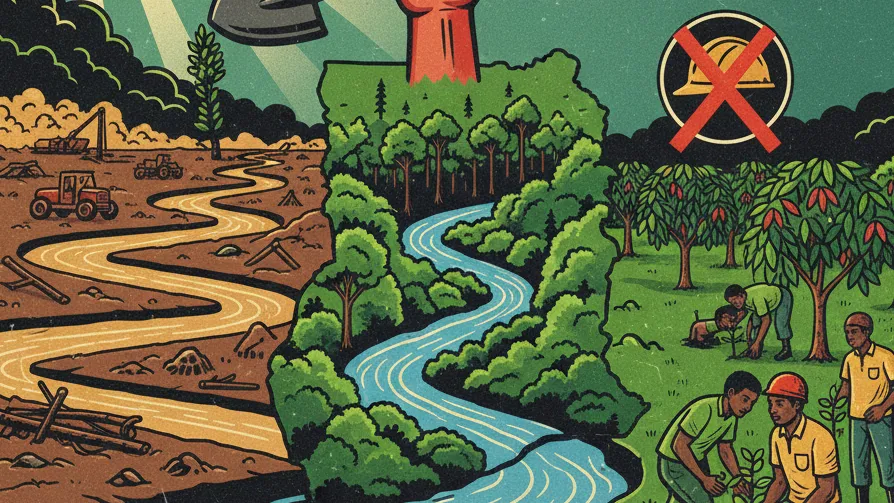
Ghana bans all mining in forest reserves to protect rivers, forests, and farmland, reversing 2022 rules and strengthening environmental enforcement.
Ghana has announced a nationwide ban on all mining activities within forest reserves, marking a decisive shift in environmental and natural resource policy. The move is aimed at protecting forests, rivers, water bodies, and farmland that have suffered extensive damage from years of illegal and weakly regulated mining. By restoring strict protections, the government is seeking to address growing public concern over environmental degradation and the long term sustainability of key economic sectors.
The ban directly targets the impacts of illegal small scale mining, widely referred to as galamsey, which has spread across 13 of Ghana’s 16 regions. Cocoa farms, forest ecosystems, and major river systems have been heavily affected, with polluted water sources posing risks to both rural communities and urban water supplies. The scale of environmental damage has increasingly strained government institutions and undermined livelihoods dependent on agriculture and clean water.
Industrial mining companies have also been affected by the spread of illegal activity, facing frequent incursions into their licensed concessions. Major gold producers operating in Ghana have reported rising costs linked to security, surveillance, and community engagement as they attempt to protect assets and personnel. These pressures have highlighted the blurred lines between legal and illegal operations and reinforced calls for stronger enforcement measures.
The new ban reverses regulations introduced in 2022 that had allowed controlled mining within forest reserves. Under that framework, nearly 90 percent of forest reserves had been opened to mining under specific conditions, a policy that critics argue weakened oversight and accelerated environmental harm. Following a 21 day constitutional period, the repeal has now taken full legal effect, restoring a blanket prohibition on mining in these sensitive areas.
Government officials have stated that the ban is designed not only to halt further damage but also to provide a foundation for long term forest restoration and sustainable land management. Stronger legal tools are expected to support enforcement agencies in combating illegal mining while encouraging alternative livelihoods and responsible resource use. In the context of Ghana’s mining industry, the policy may constrain access to certain prospective areas in the short term, but it also has the potential to improve environmental credibility, reduce conflict, and support a more sustainable investment climate over time. For the wider African mining sector, Ghana’s decision underscores a growing emphasis on balancing mineral development with environmental protection and social stability.
Mini-Glossary
- Forest reserves: Protected areas designated to conserve forests, biodiversity, and water catchments.
- Illegal small scale mining (galamsey): Unlicensed and often informal mining activities that frequently cause environmental damage.
- Licensed concessions: Areas legally granted to mining companies for exploration or production.
- Constitutional period: A legally required timeframe before new laws or regulations take effect.
- Sustainable land management: Practices that balance economic use of land with environmental protection and long term productivity.
Editor: Vural Burç ÇAKIR