
Ethiopia Launches First Gold Refinery with $50 Million Investment
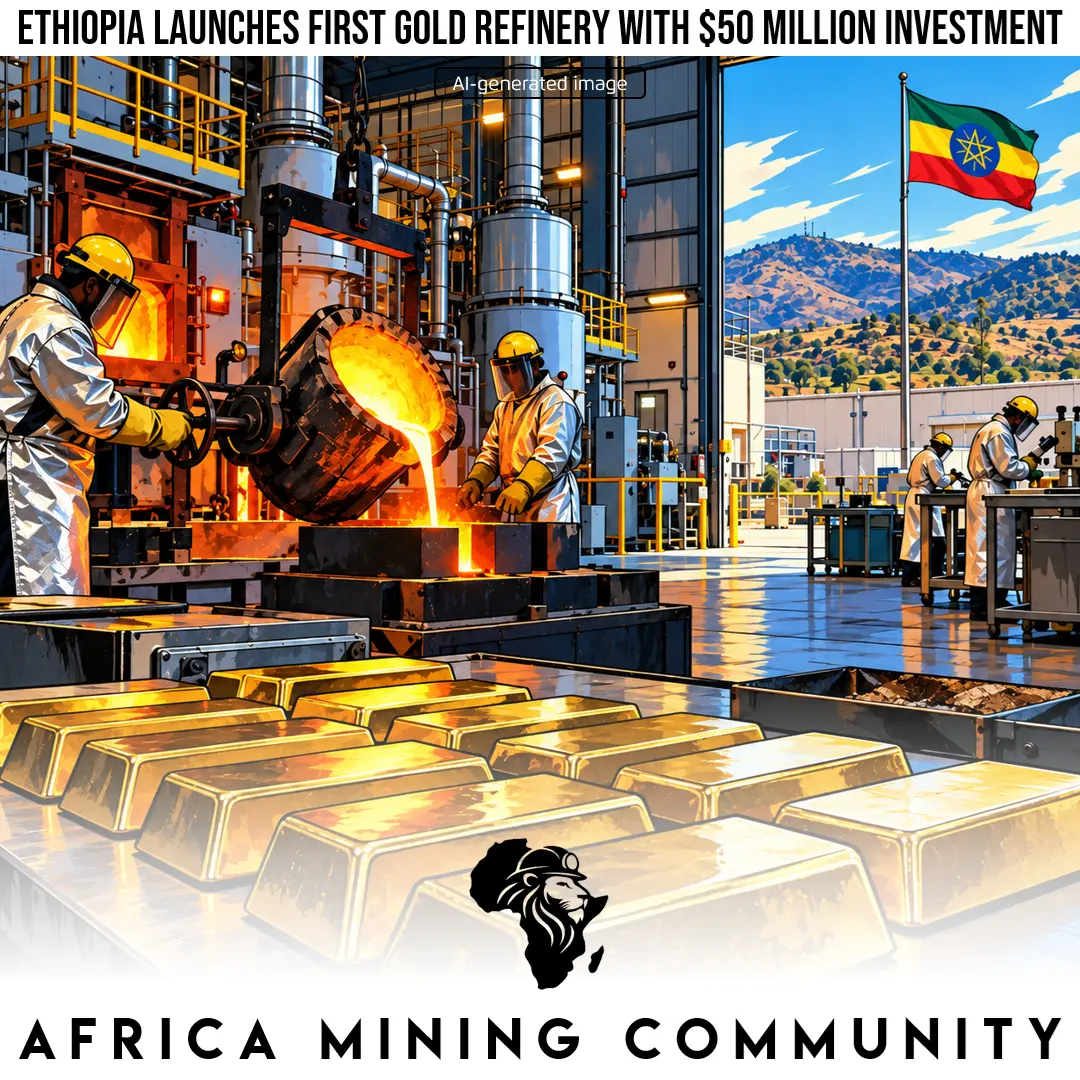
Ethiopia launches its first $50 million gold refinery, targeting regional precious metals processing, stronger exports and greater mining value addition.
Ethiopia has officially inaugurated its first national gold refinery, marking a significant milestone in the country's efforts to strengthen its mining industry, expand domestic mineral processing capacity, and establish itself as a regional centre for precious metals refining. The $50 million facility, launched on 10 October 2026 by Prime Minister Abiy Ahmed, represents a strategic investment in Ethiopia's mineral value chain. Located within the Bole Lemi Special Economic Zone in Addis Ababa, the refinery is expected to process gold from domestic mining operations and neighbouring African countries, reducing reliance on overseas refining facilities while creating new opportunities for industrial development, export growth, and regional economic integration.
The refinery has been developed through a joint venture between state-owned Ethiopian Investment Holdings (EIH) and international precious metals company Sam Precious Metals. With EIH holding a majority ownership stake, the project combines government participation with international technical expertise and investment. Its initial capital commitment of $50 million underscores Ethiopia's ambition to develop advanced mineral processing infrastructure and retain a greater proportion of the economic value generated by its natural resources.
According to Ethiopia's Prime Minister's Office, the National Precious Metals Refinery has a designed processing capacity exceeding 600 tonnes of precious metals annually at full operation. This capacity covers precious metals, including gold and silver, rather than gold alone. The facility is intended to produce export-ready bullion and precious metal bars of varying purity levels, providing an industrial foundation for Ethiopia's expanding gold sector.
The new refinery will provide a comprehensive range of precious metals processing services, including melting, testing, refining, casting, bar minting, and die-making. These operations represent important stages in the gold value chain, transforming mined or partially processed gold into high-purity products suitable for commercial transactions, industrial applications, and international markets.
The facility will also offer assaying and certification services, enabling producers to establish the purity, quality, and commercial value of their precious metals. Such capabilities are essential for improving transparency in gold transactions, establishing reliable pricing mechanisms, and strengthening confidence among buyers, exporters, and investors.
By integrating multiple processing and quality-assurance functions within a single facility, Ethiopia aims to provide domestic and regional mining companies with a more accessible alternative to overseas refining. This could reduce certain transportation and handling costs, shorten processing arrangements, and support the development of a more competitive African precious metals supply chain.
A central objective of the project is to position Ethiopia as a competitive destination for gold refining and certification across East Africa and potentially the wider African continent. Prime Minister Abiy Ahmed indicated that neighbouring countries and regional mining companies would be able to transport their gold to Ethiopia for processing, certification, value addition, and eventual sale.
This regional approach could provide mining companies with access to specialised refining infrastructure without requiring their minerals to be shipped to established processing centres outside Africa. Historically, the continent has faced challenges in capturing the full economic benefits of its mineral resources, partly because substantial downstream processing activities take place beyond its borders.
By developing domestic refining capabilities that can serve multiple countries, Ethiopia is seeking to capture a greater share of the commercial activities associated with precious metals production. If supported by internationally recognised quality standards, efficient logistics, competitive processing fees, and transparent trading arrangements, the refinery could strengthen Ethiopia's position within regional and international gold markets.
Gold remains one of Ethiopia's most important sources of foreign exchange earnings, making the development of domestic refining infrastructure particularly significant for the country's economic outlook. According to government data, Ethiopian gold exports generated approximately $5.6 billion in 2025, demonstrating the sector's substantial contribution to export revenue and foreign currency availability.
Despite this strong export performance, exporting gold without undertaking all available refining and manufacturing activities domestically can limit the additional economic benefits retained within the country. Refining operations generate revenue through processing services and can stimulate demand for specialised equipment, skilled labour, transportation, security, certification, and associated financial services.
The new refinery is therefore intended to support Ethiopia's transition from primarily extracting and exporting mineral resources toward developing a more integrated precious metals industry. In addition to improving export quality, local processing could encourage investment in jewellery manufacturing, precious metals fabrication, and other downstream activities that generate employment and additional commercial opportunities.
The facility could also support greater recovery of valuable by-products, including silver, from gold-bearing materials. Recovering these materials through appropriate metallurgical processes may improve the overall economic value obtained from mineral production.
The inauguration of Ethiopia's first national gold refinery represents an important development in Africa's wider efforts to expand mineral beneficiation and retain greater economic value from natural resource production. For Ethiopia, successful operation of the facility could strengthen foreign exchange earnings through refining service revenues, encourage investment in mineral processing, support skilled employment, and improve the competitiveness of its gold industry. At a regional level, accessible refining and certification infrastructure could help African gold producers reduce dependence on processing facilities outside the continent and establish stronger commercial relationships within Africa. However, the refinery's long-term economic impact will depend on its ability to secure sufficient gold supply, maintain internationally accepted refining standards, operate competitively, and attract sustained participation from regional mining companies. If these conditions are achieved, the investment could contribute to a more integrated African precious metals value chain and provide a practical example of how mineral-producing countries can move beyond raw material exports toward higher-value industrial activities.
Mini-Glossary
- Mineral beneficiation: Processing raw minerals to improve their quality, commercial value, or usefulness.
- Precious metals refinery: An industrial facility that purifies valuable metals, such as gold and silver, to specified standards.
- Assaying: Scientific testing used to determine the composition and purity of precious metals.
- Bullion: Gold, silver, or other precious metals in bar or ingot form, typically held for investment or trade.
- Bar minting: Manufacturing precious metal bars with standardised weights, purity specifications, and identification markings.
- Die-making: Producing specialised metal tools used to stamp designs, markings, or identification details onto metal products.
- Foreign exchange earnings: Revenue received in foreign currencies through exports or other international economic activities.
- Mineral value chain: The interconnected activities involved in extracting, processing, refining, manufacturing, and selling mineral products.
- Downstream processing: Industrial activities that transform extracted minerals into refined materials or finished products.
- Joint venture: A business arrangement in which two or more organisations share ownership, investment, risks, and potential returns.