
Chinese Firms Power $1.2B Tazara Rail Upgrade in Africa
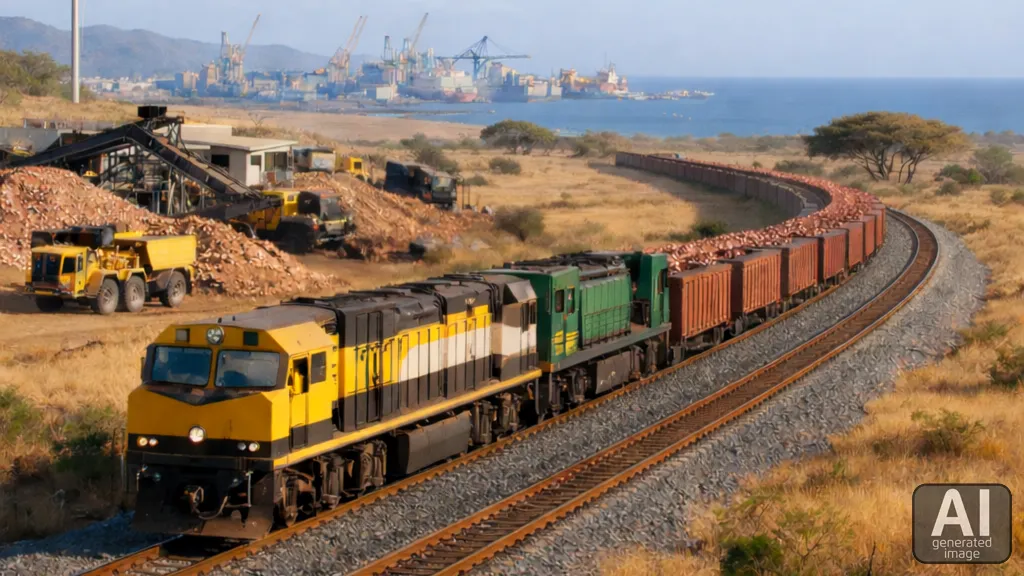
Chinese firms are investing $1.24B to upgrade the Tazara railway, boosting Africa’s copper and cobalt exports amid corridor rivalry.
The modernization of the Tazara railway marks a significant new chapter in Africa’s transport and mining infrastructure story, as a consortium of major Chinese mining, logistics, and construction firms moves forward with a $1.24 billion investment to rehabilitate one of the continent’s most strategically important rail corridors. Stretching 1,860 kilometers between Zambia and Tanzania, the historic railway connects Zambia’s copper belt to the port of Dar es Salaam, offering a vital export route for copper, cobalt, and other minerals. The project reflects not only the growing urgency of improving trade logistics in Southern and Central Africa, but also the intensifying international race to secure access to Africa’s critical mineral supply chains.
At the center of the initiative is a joint venture led by China Civil Engineering Construction Corp., or CCECC, which holds an 80 percent stake. The remaining shares are distributed among CMOC Group, Zijin Mining, COSCO Shipping, and Jiayou International, each holding 5 percent. This ownership structure highlights the strong alignment between industrial mining interests and logistics operators, particularly those involved in moving bulk commodities from inland production zones to global markets. Zambia and Tanzania have reinforced the long-term nature of the project by granting the consortium a 30-year concession to operate the railway, providing the investors with the stability needed to upgrade, manage, and commercialize the corridor over several decades.
The strategic importance of the Tazara railway lies in its role as a transport artery for mineral exports, especially from Zambia and the Democratic Republic of Congo, two countries that are central to global supplies of copper and cobalt. These minerals are increasingly critical for energy transition industries, including electric vehicles, battery manufacturing, and renewable energy systems. By modernizing rail infrastructure, the project is expected to reduce dependency on road haulage, which has long been associated with congestion, higher transport costs, longer delivery times, and greater wear on public infrastructure. Improved railway performance should allow mining companies to move larger volumes more efficiently, lower logistics bottlenecks, and strengthen the reliability of export schedules.
The project also carries historical and geopolitical significance. Originally built in the 1970s with Chinese support, the Tazara railway has long symbolized Beijing’s infrastructure diplomacy in Africa. Its revitalization shows how China is adapting that legacy to current commercial realities. Rather than relying solely on state-backed development lending, this new investment model appears more commercially driven, involving firms with direct operational interests in mining output, freight movement, and regional infrastructure control. In that sense, the deal aligns with the evolving character of China’s Belt and Road strategy, which is increasingly focused on bankable, revenue-generating assets tied to industrial and trade ecosystems.
At the same time, the Tazara upgrade is unfolding in the context of mounting corridor competition in Africa. It stands as a direct logistical alternative to the Lobito Corridor, which is backed by the United States and the European Union and is designed to connect Central African mineral zones to Angola’s Atlantic coast. While the Lobito route is positioned as a Western-supported supply chain gateway, the Tazara corridor strengthens China’s presence along the eastern export axis. This rivalry is not only about infrastructure, but also about long-term influence over how Africa’s strategic minerals reach international markets. Chinese companies remain deeply embedded in the Democratic Republic of Congo’s copper and cobalt export system, while Western firms continue to maintain stronger positions in Zambia, making transport corridors an increasingly important arena of competitive advantage.
From an economic and mining industry perspective, the upgraded Tazara railway could have far-reaching effects across the region. For Zambia, Tanzania, and potentially the Democratic Republic of Congo, better rail connectivity may improve export competitiveness, reduce freight costs, and encourage additional upstream and downstream investment in mining and processing. Tanzania could benefit from stronger port throughput and transit trade revenues, while Zambia may gain a more dependable route for mineral exports. More broadly, the project may deepen regional integration and reinforce Africa’s role in global critical minerals markets. However, it may also heighten external dependence on foreign-controlled logistics systems if local governments do not pair infrastructure upgrades with stronger value addition policies, regulatory oversight, and domestic industrial participation. In this sense, the railway’s revival could become either a catalyst for broader economic transformation or simply a more efficient channel for raw mineral extraction, depending on how African stakeholders manage the opportunities it creates.
Mini-Glossary
- Concession: A long-term agreement that gives a company the right to operate and manage an asset such as a railway.
- Critical minerals: Minerals such as copper and cobalt that are essential for modern technologies, including batteries, electric vehicles, and clean energy systems.
- Export corridor: A transport route, often involving rail, road, and ports, used to move goods from production areas to international markets.
- Joint venture: A business arrangement in which multiple companies invest in and manage a project together.
- Logistics: The planning and movement of goods, materials, and services from one place to another.
- Supply chain: The full network involved in producing, transporting, and delivering a product to the final market.
- Throughput: The volume of goods or materials that can pass through a transport system, port, or facility over a period of time.
- Value addition: The process of increasing the economic worth of raw materials by refining, processing, or manufacturing them into higher-value products.
Editor: Vural Burç ÇAKIR