
Burkina Faso Opens First Gold Refinery to Boost Local Mineral Value
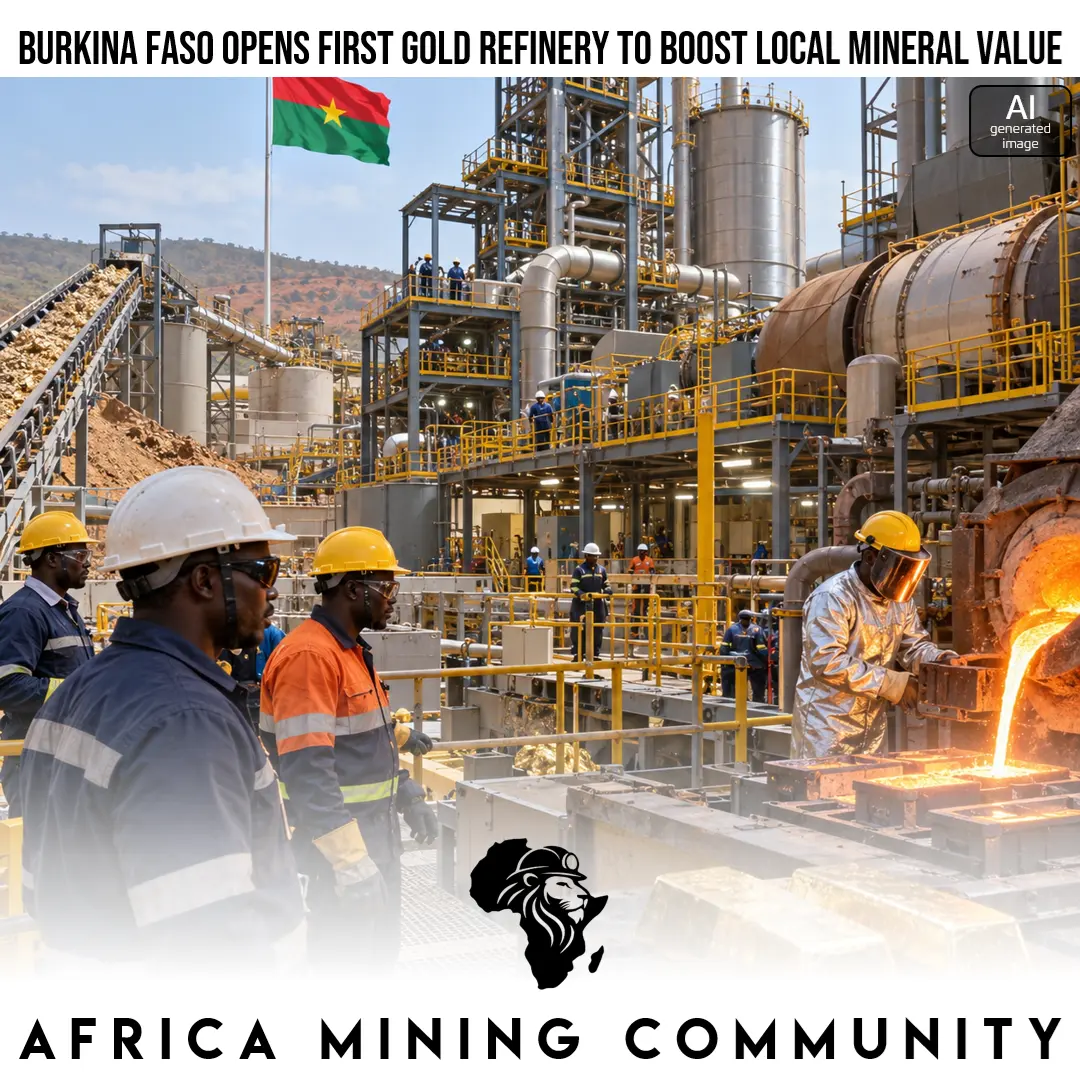
Burkina Faso opens its first gold refinery, expanding local processing capacity and supporting a wider African push for mineral beneficiation.
Burkina Faso has inaugurated its first gold refinery, marking a significant step in the country’s efforts to process more of its mineral production domestically and retain a greater share of the economic value generated by its mining sector. The state-controlled Raffinor BF SA facility, located in the capital Ouagadougou, was developed at a cost of 11 billion CFA francs, approximately $19 million. The project forms part of a broader government strategy to strengthen domestic mineral processing, reduce dependence on overseas refining and develop new industrial capabilities linked to the country’s substantial gold production.
Raffinor BF SA has an initial refining capacity of 164 tonnes of gold per year, providing Burkina Faso with considerable room to process its current domestic production. According to the Ministry of Energy, Mines and Quarries, the country produced approximately 94 tonnes of gold last year. This means the refinery’s first-stage capacity already exceeds annual national production, potentially allowing the facility to accommodate future increases in mine output or process gold originating from elsewhere in the region, depending on future commercial arrangements and government policy.
The refinery has also been designed as a modular facility, allowing additional processing lines to be installed as demand increases. Under a planned second phase, annual refining capacity is expected to rise substantially to 515 tonnes. Modular development can give operators greater flexibility by allowing processing infrastructure to expand progressively rather than requiring the entire future capacity to be constructed at the outset. If fully implemented, the second phase would position the facility with refining capacity significantly above Burkina Faso’s present gold production levels.
The government sees domestic gold refining as part of a wider industrial transformation strategy. Historically, many African mineral-producing economies have exported commodities in raw or semi-processed form, leaving substantial portions of downstream processing, refining and associated economic activity outside the producing country. Establishing domestic refining capacity can help retain more stages of the mineral value chain within the national economy, while potentially supporting skilled employment, technical expertise, laboratory services, logistics, financial services and other industries connected to mineral processing.
Burkina Faso’s initiative also reflects a broader policy shift taking place across several African gold-producing countries. Governments are increasingly pursuing local beneficiation policies intended to increase domestic participation in mineral processing and reduce reliance on the export of unprocessed resources. These strategies vary considerably between countries, but they generally seek to ensure that mineral production contributes to industrial development beyond the extraction stage.
Guinea, for example, has moved to restrict exports of raw gold as part of its efforts to encourage domestic processing. Ghana has also prohibited exports of unrefined gold produced by small-scale miners, reinforcing efforts to increase oversight and domestic participation in the gold value chain. Mali, another major West African gold producer, is developing its first gold refinery through a joint venture involving Russia’s Yadran Group, while Ivory Coast is also planning to establish a refinery, with operations expected to begin in the first half of next year.
The emergence of new refining projects across West Africa illustrates how governments are reconsidering the economic structure of their mining industries. Gold refining can potentially generate additional economic activity by creating demand for specialised equipment, analytical laboratories, security services, transportation, technical training and financial infrastructure. Refined gold can also meet recognised purity standards required by international markets, although the economic benefits ultimately depend on factors such as refinery utilisation rates, operating costs, governance, access to reliable gold supply and the ability of facilities to meet internationally accepted certification and responsible sourcing requirements.
For Burkina Faso, the Raffinor BF SA refinery could strengthen the country’s position within the regional gold value chain while supporting its broader ambition to translate mineral wealth into industrial development. If sufficient production is channelled through the facility and expansion plans proceed successfully, the refinery may contribute to greater domestic value retention, specialised employment and stronger linkages between mining and other sectors of the economy. More broadly, similar projects across Burkina Faso, Ghana, Guinea, Mali and Ivory Coast could gradually reshape West Africa’s gold industry by shifting a larger share of refining and mineral processing activity closer to the countries where the resources are extracted. The scale of the eventual economic impact, however, will depend on commercial competitiveness, regulatory implementation, investment conditions and the capacity of governments and operators to develop internationally competitive refining industries.
Mini-Glossary
- Beneficiation: The processing of raw minerals to increase their value before they are sold or exported.
- Mineral value chain: The series of economic activities associated with minerals, including exploration, mining, processing, refining, transportation and marketing.
- Downstream processing: Industrial activities that take place after mineral extraction, including refining and manufacturing.
- Modular facility: An industrial plant designed so that additional production or processing units can be added as capacity requirements increase.
- Refining capacity: The maximum quantity of material that a refinery is designed to process during a specified period.
- Value retention: The portion of economic value from a natural resource that remains within the producing country through processing, employment, taxation and related economic activities.
- Utilisation rate: The percentage of a facility’s total production capacity that is actually being used.
- Responsible sourcing: Standards and procedures designed to ensure that minerals are produced and traded in accordance with legal, environmental, social and ethical requirements.
Editor: Vural Burç ÇAKIR